

April 2026
The views and opinions expressed in this blog are solely those of the author and do not necessarily reflect the official policy or position of Education Insights Center (EdInsights) or the California Education Policy Fellowship Program (EPFP).
Ashley Powers Clark, Homeless Education Services Program Coordinator
For the past fourteen years, I have worked as a homeless liaison—a federally mandated role at the crossroads of public education and the housing crisis—responsible for identifying, supporting, and advocating for students who are experiencing homelessness. In a role shaped by intersecting injustices, crisis has been a defining condition of my work.
But now I am facing a level of devastation that feels unfamiliar even to long-time educational warriors. Last week, facing the threat of state takeover, our school board voted to lay off the entire district office, threatening the infrastructure that makes it possible for students experiencing homelessness to access school, stability, and support. And my school district isn’t the only one.
As the windfall of pandemic funds dries up, school districts across California are confronting deep structural deficits. At the same time, federal immigration crackdowns have sent waves of fear through school communities, forcing educators and local leaders to scramble to protect immigrant students while the media blasts images of five-year old children being detained. Meanwhile, educators themselves are reaching a breaking point — overwhelmed, exhausted, and increasingly walking out in strikes across the state.
These concurrent crises are no longer distant background noise—they are daily operating conditions.
This raises an urgent question:
What does educational leadership look like in the face of widespread, systemic disasters?
Ecosystems have a way of revealing truths that human systems often forget and here in California, the poppies are exploding in defiant orange in the most hostile places—sun burned roadsides, gravel shoulders, the thin seams of broken asphalt. The flower has a lot to teach us.
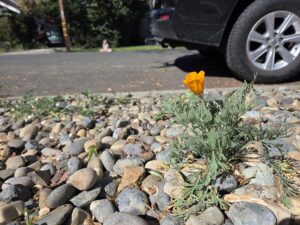
A photo the author snapped of the Poppies growing through the rocks that line her driveway. The author steps on them daily, and they are still blooming.
It has learned how to live with California’s extremes—drought, fire, and flood—not by resisting them, but by adapting to what each season demands.
Here, I offer a few lessons from the California poppy’s relationship with disaster, in hopes of inspiring us as educators as we find our way through this season.
Drought: The Post-Covid Budget
Education systems were inundated with funding during COVID. Now, the drought has arrived.
When funding, energy, and resources are scarce, growth is not the primary strategy—protection is. Education leaders are trained to think in terms of scale and systems-wide impact. Did we change outcomes for the whole school? The whole cohort of students?
But scarcity changes the math. Hard-fought progress and years of program development disappear in a single budget cycle. It hurts. There is rage and grief.
Veteran educators recognize the feeling. We build things knowing they will vanish, and then sit through staff meetings where the loss goes unspoken even as the anger, exhaustion and cynicism settle heavily in the room.
The California poppy offers a different model for survival. In drought conditions, rather than expanding, it sends a deep taproot into the soil to reach hidden water. When the land grows too dry, the foliage above ground recedes and the plant goes dormant, conserving energy and waiting for rain. Visible growth pauses, but the life of the plant persists underground.
In this season, leadership becomes less about expansion and more about containment and protection.
As a visionary, this shift in perspective is not easy. There are days when I have felt completely shaken to the core—my internal compass wobbling, frozen, anxious, and scared. If I can’t plan ahead, then who am I now?
What has helped most in these moments is focusing on new strengths. Many educators are familiar with the CliftonStrengths assessment. For years, my top strengths—Strategic and Ideation—have guided how I move through the world: mapping pathways before others can see them, generating possibilities, anticipating what’s next. But recently, a coach told me, “Your top strengths are tired. They need a break.”
So I’ve been practicing something different.
I’ve been leaning into Adaptability—not as a personality trait, but as a daily practice. It looks like releasing the need to have a five-step plan before I begin. It looks like walking into a meeting without knowing exactly how it will unfold, and trusting myself to respond in real time. It looks like letting the day shape me, instead of trying to shape the day.
I’ve been exploring Connectedness—paying attention to the invisible threads between people, systems, and moments. It shows up when I slow down enough to notice that what feels like chaos is often part of a larger pattern. It’s the quiet reminder that I am not holding this work alone, even when it feels that way—that there are histories, relationships, and shared commitments carrying us forward.
And I’ve been grounding myself in Belief. Not belief as certainty, but belief as anchor. It shows up when I return to why this work matters, especially when the path forward is unclear. It’s the decision to keep showing up for students, for community, for justice—even when I cannot see the outcome. It is less about knowing, and more about trusting.
These strengths feel different. They are less about control and clarity, and more about presence, relationship, and purpose.
After all, all strengths also have shadows and there are downsides to being a “visionary.” When we fix our eyes too far ahead, we miss what is right in front of us: a relationship, a staff member who needs steadiness, a volunteer who wants to give more, a student whose trust can be strengthened.
California poppy seeds can remain in the soil for decades—waiting for the chemical signal of smoke and heat before bursting into color across the landscape. It’s important to remember that when our work on the surface appears “gone,” it has not disappeared. It has been stored. Encoded. Held beneath the surface, waiting for the right conditions to reemerge in another form.
This may be why so many education initiatives across time and place echo the same core principles (i.e. whole child turns to Multi Tiered Systems of Support (MTSS) to Community Schools). We already know what works. Again and again, political winds tear systems apart—defunding, restructuring, renaming—but the same truths keep pushing back through. Relationships matter. Stability matters. Dignity matters. Systems that center those truths find their way back, even after disruption.
In this season, dormancy is not failure.
It is strategy.
It is preservation.
It is the quiet, stubborn insistence that what matters most is not lost—only waiting.
Wildfire: Immigration Raids
The bright red stop signs that read “STOP ICE” have become a defining feature of the landscape now — flashing past my windshield each morning as I drive my kids to school. They are small signals of the fear and resistance that have settled into daily life.
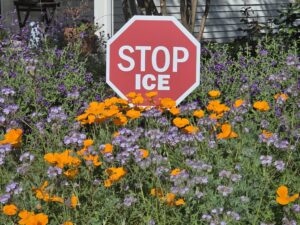
Poppies surrounding the signs of resistance in the author’s neighbor’s native garden.
I was leading a staff meeting in the aftermath of the murders of Renée Good and Alex Pretti. The agenda I had prepared hours earlier no longer matched the reality we were standing in. In moments like that, adaptation begins with rapid reorientation — understanding the terrain you are actually standing on, not the one you planned for. When the linear logic of a strategic plan fails, creativity and adaptability become the skills that build resilience.
The California poppy survives disturbance in much the same way. After fire clears the land, these bright orange flowers are often among the first to appear, rapidly colonizing open ground. They produce abundant pollen rather than nectar, attracting many different insects instead of relying on a single pollinator. It is a strategy built for uncertainty—spreading possibility widely so renewal never depends on one fragile pathway.
The strategy we built that morning mirrored the same principle. As the conversation unfolded, our student information systems became less like a database and more like a living map. I pulled data and generated a hotspot map showing where our foreign-born, unhoused students were concentrated.
With that information, we worked with a trusted community partner to quietly convene a small group of advocates and service providers. Each brought something different—relationships, food access, transportation, volunteer coordination. Diversity became our strength, the way the poppy’s pollen draws many different insects to the same flower. Together we mapped resources, defined roles, and built food delivery routes so a volunteer could move quickly if families suddenly needed support. No announcement. Just rapid preparation.
The plan we created to protect our neighbors is another seed we have buried together. We hope this one never blooms.
Flooding: Working with Overwhelm
There are seasons when nervous systems and institutional systems are flooded. Bureaucratic and political violence outrun human endurance—and still most workplace cultures demand that we show up to work each day as if nothing is happening.
But the creativity of adaptation reminds us that there is always another way to move through the world.
A young staff member recently came into my office in tears, afraid she cannot tolerate this level of stress and uncertainty much longer. This is her first job since graduating college.
After she left, I found myself sitting there, thinking about who I was in my twenties—working in youth organizing, buoyed by the belief that our efforts might actually change the course of things. There was urgency, yes. There was struggle. But there was also a kind of fuel in that hope.
There is a psychological load we are asking our young professionals to carry—chronic uncertainty, moral distress, systems that feel unstable or even misaligned with the values that brought them here in the first place. They are being asked not just to do the work, but to hold the weight of its contradictions that my generation never had to confront.
I feel ill-equipped to respond to that. I feel the limits of what I can offer in a moment like this—no clear reassurance, no stable ground to point to.
Poppies do not thrive during a flood. Sustained periods of inundation cause their roots to rot.
I’ve realized that what I have to offer is not answers, but a different set of questions.
In times of crisis, the leadership questions shift and quietly turn inward, away from, “What did we accomplish today?” Toward deeper ones: “Who were we today, how do we need to show up tomorrow, and who must we become—together—to survive?”
In this season, success can’t be measured only by outputs, so I ask different questions: “Was I attuned to the needs of my team? Did I read the weather and adjust accordingly? Did I leave the office with my nervous system intact?”
I also don’t hide my emotions. When you work in the field of homeless education long enough, the work becomes a lifelong lesson in learning how to cry.
In my younger years, I often cried in the bathroom alone—contained, hidden, trying to hold it all together. Now, I cry openly.
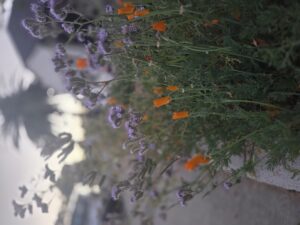
Poppies curling up after the sun goes down—a flower that knows a collective riot also requires collective rest.
Tears make visible what we are all carrying. It reframes vulnerability—not as a loss of leadership, but as a form of it. We cry not because we are unraveling, but because we are refusing to pretend that this moment is something it’s not.
And over time, we learn how to let the sadness move through us, rather than flatten us.
Leaders can create spaces where people feel both protected and permitted to fall apart. Leaders should not expect sustained productivity under pressure, but rather focus on preserving capacity—in ourselves, our spirit, our teams, and our schools—until safer conditions return.
In the springtime poppies emerge on California hillsides not as individuals, but as a collective resilient community. Poppies do not compete to be the strongest flower—they survive by arriving together, resting when needed, and leaving seeds for the seasons they cannot endure.